
Finding the right market for your product is one of the key ingredients to having a successful business. You will find countless makers out there that tell you “do your research”, but then want to charge for their guide. This blog will serve as my guide and will be a living document updated from time to time as I continue to grow my small business.
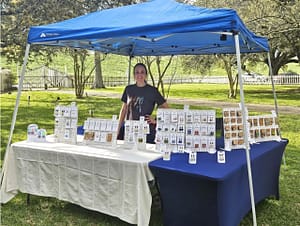
Where do you even start?
This is one of the easiest questions to answer as the simplest answer is just: somewhere, anywhere. While research is fundamental, at the end of the day, you have to just start somewhere so I’ll walk you through how to wisely do that.
Analysis paralysis is a real thing and a common road block for many people wanting to start their own small business. We think we need to get everything perfect before we show the world what we have. When you are starting out whatever you have won’t be perfect, it might not even be that good, but that’s ok, you have to start somewhere. As you can see from my picture above I have a long way to go, but I’ve already learned so much and have many fresh ideas to apply to my upcoming markets.
Just dive in!
Initial research
Find a local farmer’s or craft market that gets a decent amount of foot traffic and has more than just food booths (if you are are in the arts and crafts business). Take a trip and scope the market and vendors out before you show there.
Start low-stakes
Find a small local market that you can get into without a high vending fee. For me in the southern US that is around $20-$35. If I vend at this market and don’t even make rent it’s not a huge loss. This keeps the pressure off and the stakes low. This is a great opportunity to get a feel for vending, to meet customers and ask options, and to meet your neighboring vendors who often have local insider market knowledge that can save you some headache. Consider these your practice markets while you build your business.
Find better markets
Farmer’s markets are great for getting your feet wet, but may not have much of a “craft/art” audience. It is important to note that a craft market and a farmers market are not the same thing, but they may be combined. This is very location specific. In my area that farmer’s markets are filled with patrons that go there specifially for food items. They are not going there to buy jewelry or art. I have spoken to some vendors who live in towns that are have a large arts community and thus their markets look very different.
That is one thing to note when sifting through markets:
- What kind of market is this? (food/shopping/arts/community event)
- Who is attending? (demograhics)
- What are they going there to buy? (grocery shopping/listening to a band/art patrons)
Who is your audience?
Finding your right market and finding your target audience are two sides of the same coin. You need to be doing both at the same time. Every market you participate in is research. It’s an opportunity to further define who you are selling to. Even at the low stakes markets you start at you should be learning something.
Pump up the research
Once you get a market or so under your belt you should have more data and more direction. Both from a product standpoint and from a market standpoint. This blog covers the market improvement side of things, but don’t ignore your products, your products are your main focus!
How to find bigger markets
Short answer: social media. Facebook is a great place to look for events in two ways.
Searching for events
Go straight to Facebook Events and look for other local markets in your area and nearby region if you are ready to start traveling. On the event page you can see how many people are “interested” and how many people are “going”. I currently think “going” is mostly just vendors and workers of the event so I focus on the interested number. The interest will grow as the event date gets closer, but if it’s a few months away and there is already a good bit of interest that is a great sign. A good way to check interest if you are looking a ways out into the future of a yearly event is to check the past Facebook event page and see how many people were interested in that one.
Large events are often competitive and offer limited spots. Applications can be due around 6-9 months in advance so if you are waiting on a big event to pop up on your feed then it may be already too late.
Browse the web
Check out these websites to search for events in your region
- Fairsandfestivals.net
- has a great search option to narrow down your region and type of market
- also has some great educational resources for new vendors and makers
- Zapplication
- this is an application website
- it has a great art show search option you can use to find markets that might be a good fit for your products
I usually use those website to find markets or events, then go to Facebook or Instagram to scope out the past events and see how well the organizers advertise.
Verifying events
This is where your vendor or market network comes into play. Join local vendor Facebook groups where you can ask other vendors about certain events or details. When you are currently vending talk to your neighbors and ask them about certain events. Be nosey, it helps.
Know what is appropriate and what is a scam. There is no shortage of scammers out there pretending to be event organizers. Don’t let those ugly chatGPT flyers fool you. What’s almost as bad as an outright scam is event organizers who don’t promote the event. It may be a real event, but if you don’t have hardly any customers show up what’s the point? Again ask around.
Look ahead!
Make a calendar
Application dates are sometimes 9 or so months BEFORE the event even takes place. By the time the event notification gets advertised to you, applications are often closed. When you find an event that you might be interested in, go to the application and see when the deadline and application opening is. Save the event website link and application opening and closing dates on your calendar for the upcoming season, that way you don’t miss it again. I usually put my opening dates a few days before the current events dates.
Do you have any tips and tricks for arts or craft market vendors?
This is my journey and findings thusfar. I’ll update and refine as I progress and build my business. If you’ve got some insights I’d love to hear them! Drop them in the comments below. I prefer not to have to learn everything the hard way, but let’s be honest, that’s just how I roll!